“Just don't look down” is useless advice, because looking down is not a bad habit — it is a working solution to a real problem: finding a key whose address the hand does not know. Until something better exists, the ban only makes typing slow and tense.
The useful question is different: what should replace the glance?
What replaces the glance
A reference point you can feel. The index-finger keys carry small bumps you can find by touch. From them the hand takes home position without looking: four fingers on the middle row (ASDF — JKL; or ФЫВА — ОЛДЖ), thumbs on the space bar. This is the one position you need to be able to take blind; everything else is measured from it.
Knowing the path, not the address. Knowing that “p” is the third key from the right in the top row does nothing for your hand — you cannot move a finger with that fact. What helps is different: where this particular finger goes from its own home — slightly left, up, down. That is what practice consolidates.
Returning home after every press. If the finger stays where it landed, the hand loses its reference, and the next movement needs a glance again. The return restores a known position, so the return belongs to the exercise itself.
Why covers and blank keycaps work poorly
Covering the letters or hiding your hands behind a screen is a popular trick, and it honestly solves one thing: looking becomes pointless. The trouble is that nothing is offered in exchange. The hand still doesn't know the path, so it searches by trial — press, wrong, try the neighbour. What gets consolidated is guessing, and accuracy falls exactly when you need it most.
The trick has its place later, as a test: the movements are already there and the cover merely removes temptation. At the start it does harm.
An on-screen keyboard is still looking
Trainers that draw a keyboard and light up the next key look like a gentle alternative: head up, eyes on the screen. But the action is the same — the eye finds an address, the finger follows. The skill grows around the hint, and when the hint goes away speed drops just as it does when you look up from real keys.
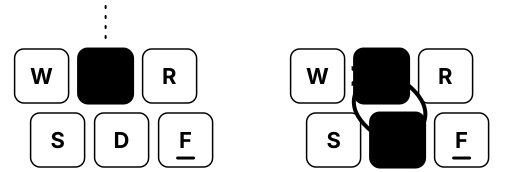
This is why FlowTyping doesn't show a keyboard with the target lit. What it shows is movement: an arc from the finger's home key to the letter and back. You can watch it as long as you like — it doesn't tell you where the key is, it shows what the hand does. Once a movement is learned the hint becomes unnecessary on its own: the hand gets there before the eye has read it.
Leaving the habit
Not everything at once. Giving up glances for the whole alphabet at once means a severalfold drop in speed and an almost certain relapse. The opposite works: a small set of letters brought to confidence, then the next one. That is how the trainer is built — index fingers and the space bar to start, and a new group opens when the previous letters land on the first press without hesitation.
Slow enough to land. Speed is not the goal at this stage. The goal is that each movement is correct: a wrong one is remembered just as well as a right one and needs unlearning later.
Short, and daily. A few minutes every day beat an hour once a week: motor skills grow with the count of days you practise, not the length of any one sitting. Even a one-minute session counts.
Don't switch back when it gets hard. The urge to finish that work email the old way is understandable, but oscillating between two methods is exactly what stretches the transition out: neither habit finishes forming.
What to expect, and when
The first days are the worst: typing is slow, mistakes are frequent, and the eyes keep pulling downward. After a week or two of regular short sessions, home position and the common letters stop asking for attention, and glances survive only on rare characters and punctuation — that is where the habit goes last.
The drop in speed during this period is not a sign that something is wrong. It is the ordinary price of changing a motor habit, and it is paid once.
If the working day won't wait
Then split it sensibly: practice blind, work however you can — with two caveats. First, keep your hands in home position even while glancing down; that keeps the reference forming. Second, carry into your work only the letters that are already confident in practice, instead of waiting for the whole alphabet. The transition then happens gradually, without a day when everything falls apart at once.