Learning finger placement comes with a standard set of troubles: keys that refuse to be remembered, fingers that wander off position, an old habit that grabs the key with whatever finger arrives first. None of this is a sign that the method isn't working — all of it is ordinary motor learning, seen from the inside. Each trouble has a matching move, and most of them are about practising less at a time, not more.
What goes wrong, and what to do
Fingers lose the home position after a long reach. The reach gets practised, the return does not — so after a far key the hand settles somewhere new and every next distance is wrong. Treat the return as half of the movement: pressed, returned, a beat of pause. Check the position by the bumps on F and J (А and О) — by touch, not by a glance down.
Neighbouring keys keep getting confused. The ring and little fingers mix up their columns longer than the rest — that is anatomy, they are the least independent fingers. The fix is to slow down until presses are clean: accuracy is the anchor, and speed grows out of it. Practising fast with errors consolidates the errors just as reliably as the letters.
The wrong finger keeps reaching out. A self-taught habit sends the familiar finger to a key that now belongs to another. Re-learning means blocking the old path: short sessions on the conflicted keys only, slow enough that the correct finger wins every time.
Glances at the keyboard sneak back for the hard keys. This one has its own page — the short version is that a ban doesn't work until the hand knows the path; give it the path first.
Errors pile up at the end of a session. That is fatigue, not lost progress. Ten minutes daily beats an hour once a week by a wide margin — distributed practice is one of the most reliable effects in skill learning. Growing errors are the signal to stop: past that point you are practising your mistakes.
Pinkies: the weakest fingers on the busiest keys
Enter, Backspace and Shift hang on the right pinky whatever the layout, so it tires first and misses most. Two things help, and neither is strength training — the skill is precision and independence of movement, not muscle.
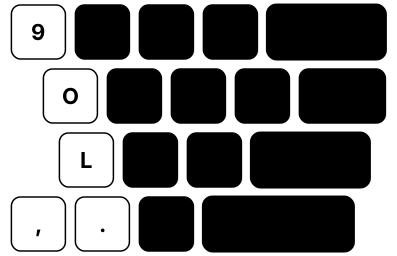
Give the pinkies their own short series: their home keys, the outer columns, then Enter and Backspace, always with the return home — and in small portions, since they fatigue before every other finger. And split the load that can be split: Shift is taken by the hand opposite to the letter, so the right pinky holds only half of the capitals. A relaxed pinky beats a tense one — if it stands splayed and stiff above the keys, that is where the misses come from.
A ladder of exercises
Lead-in drills, before any letters. Blind landing: hands off the keyboard, then find the home position by the bumps alone — ten times, until it is one motion. Then rise-and-return: each finger in turn presses within its own column and comes home, no words, no hurry. This is what the placement warm-up in the trainer does.
The base. Typing within the home row itself, then adding one row at a time. A new movement is practised in isolation first, then mixed into everything learned before. The mixed practice feels harder and messier — and is exactly when the durable remembering happens; the isolated version feels smooth because it demands less. Don't trust smoothness as a measure of progress.
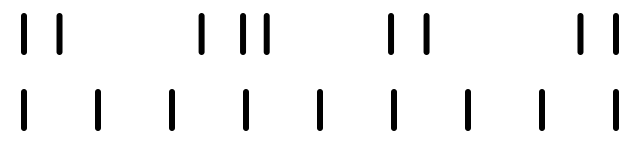
Advanced work. Evenness: type at a steady beat, letting the rhythm — not the burst — set the pace; an even interval between presses is a marker of expertise, not a side effect. Then the friction points: pairs of letters that share one finger, taken as short deliberate series. And harder text with the eyes on the screen only — by this stage the cover-the-keyboard test finally becomes useful.
How much, how often
Short daily sessions win. A few minutes, stopped while presses are still clean, do more for the hand than a long push — and leave you willing to come back tomorrow. The trainer's sessions are a minute long for exactly this reason.