A common story: someone has typed for years, reached some speed, and stopped. There is plenty of practice — every working day — and no improvement. The cause is almost rarely a lack of effort. It is what, exactly, the practice repeats.
A skill grows from repeating the movement you want to consolidate. If what repeats is a movement with a visual search for the key, then the visual search is what gets consolidated. Further practice makes you faster at searching, but no closer to typing without searching — that is a different skill, and the transition does not happen by itself.
Three things that hold the ceiling down
Looking down. Every trip of the eyes to the keyboard and back costs a fraction of a second, but you pay it hundreds of times per page. Worse, after each return you have to find your place in the text again. The limit here is not your fingers, it is the cycle: look, find, press, return.
Uneven rhythm. The number on the counter is an average. It is made of quick presses on familiar letters and stalls on the ones the hand is still recalling. The stalls are more expensive than they look: one long interval eats the gain from a dozen short ones. While the spread is wide, pushing the confident stretches barely helps.
Corrections. A mistake costs three or four keystrokes, not one: notice, delete, retype, return attention to the text. Typing at 92 % accuracy feels like “almost no mistakes”; in time spent it is roughly the same as typing a quarter slower — only with irritation added.
Why “try to go faster” doesn't work
Forcing the pace raises the share of misses, and misses give the time straight back. It becomes a seesaw: faster, less accurate, corrections eat the gain. Average speed stays where it was for weeks — what grows is fatigue.
There is a second, less obvious reason. A fast movement is a collapsed movement: it no longer needs attention and runs as one piece. It can only collapse after enough clean repetitions. Demanding speed earlier doesn't accelerate the collapse — it substitutes a different action, guessing, which misses more often.
The working rule is unintuitive: to get faster, type slower for a while — just slow enough to land on the first press.
What actually moves the plateau
Remove the glances. This is the single biggest gain and the least pleasant one: speed drops for the first few days. But the whole look-and-return cycle disappears with it, and the ceiling lifts at once.
Even out the rhythm. Aim for equal intervals between presses rather than a high tempo. Even intervals mean the movements have collapsed; after that, speed grows without special effort. FlowTyping keeps a quiet rhythm channel under the typing line for exactly this — it measures how even the intervals are, nothing else.
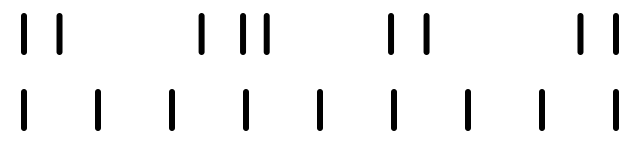
Find the specific weak spots. “Speed” is too blunt a measure to train against. It is more useful to know which characters consistently stall you and which pairs you confuse: a skill usually sags on a dozen letters, not on the whole alphabet. The trainer tracks first-press accuracy and latency per character — the time from a character appearing to the key going down — and points out the substitution you miss on most often.
Type text, not drills. Isolated letters and random strings consolidate movements but not the transitions between them; in real words the fingers learn sequences, and sequences are what speed is made of.
About the numbers
Typing speed is measured in characters per minute (cpm) or words per minute (wpm, where a word is conventionally five characters). Rough landmarks: 150–200 cpm is confident everyday typing, 300 cpm and above is fast. Exact figures depend on the language and the text, so the only comparison worth making is your own results against each other, on similar material.
Two other numbers matter more than the absolute one: first-press accuracy and rhythm evenness. They predict whether speed will keep growing. Rising speed with falling accuracy only stores up misses that will need unlearning later.
If you are relearning
A special case is moving from your own method to touch typing. Speed drops immediately and visibly: the old habit interferes with the new one. This is expected and limited in time; the dip is crossed once.
The only thing that stretches it out is oscillating between methods — falling back to the familiar one whenever a deadline presses. Then neither habit finishes forming, and the plateau becomes permanent.